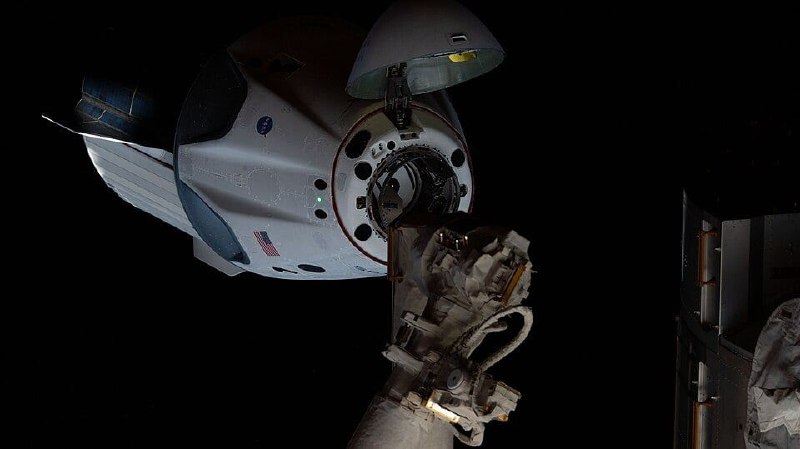
Researchers at Stanford (United States) designed an artificial intelligence that teaches spacecraft to "imagine" docking with the International Space Station (ISS) before firing the engines. The news was announced through the Telegram channel Signals from Space.
The docking seems simple, but it is a delicate orbital choreography: the spacecraft and the station travel at about 28,000 km/h, almost as if driving on a highway at maximum speed and parking in parallel in a garage of a multi-billion dollar laboratory that moves at the same speed. When accelerating forward, the vehicle tends to "float" above the orbit, and without friction from the air there is no natural way to brake. One mistake is enough to destroy the mission and generate debris that threatens dozens of satellites (Universe Today).
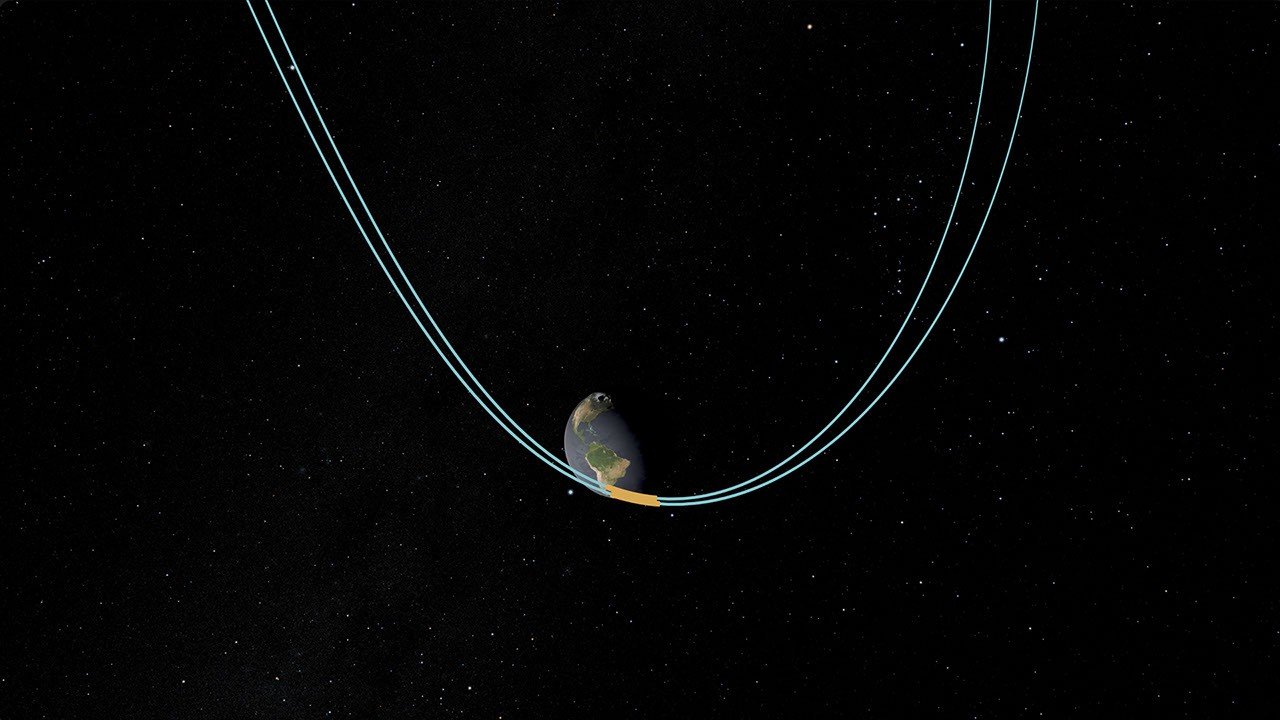
You may also likeNASA completes flybys of Earth with ESPACADE and heading to MarsFor decades, this maneuver was solved with physical equations and human pilots correcting the trajectory. The new approach, called Out-of-this-World-Model (OWM), is a model of the world: an AI architecture that learns the physics of the environment from experience, not from programmed equations. The system "dreams" dozens of possible futures, plans several steps, and only then executes the safest maneuvers before firing the thrusters (arXiv).
The model was trained in a docking environment with the ISS developed on JAX that simulates hundreds of thousands of flights on GPUs using a library called AstroJAX. The results highlight its efficiency: the OWM required only 500,000 iterations to master docking, compared to 25 million for a comparable reinforcement learning (RL) system. In tests, it managed to dock successfully in 53% of maneuvers compared to 29% for the RL, and in never-before-seen ports on the ISS it doubled baseline performance (40% vs. 17%) (Phys.org).
In addition, the system detected anomalous objects during the approach with 98% accuracy, a key ability to react to unexpected situations, such as a capsule already docked in the planned port. Even with these figures, the team itself recognizes limitations: short-distance operations showed difficulties due to the high weight given to collisions, a detail that may be adjusted in future versions (Universe Today).
The work, presented at the AMOS 2026 conference, is published as a preprint on arXiv and its code is open: the simulation environment and model architecture are available for other labs to continue the study of this paradigm. However, the technology still needs to move from paper to space: for now it is just simulation, and it will be time before an autonomous system takes full control of a real docking, and even more so in manned missions (arXiv).
You may also likeAWS says data centers in space won't be viable for 10 or 20 yearsSources: Signals from Space (Telegram).
Sources: arXiv (preprint 2609.03067) · Universe Today · Phys.org · Stanford Aeronautics and Astronautics · Signals from Space (Telegram). Image credit: Signals from Space (Telegram).