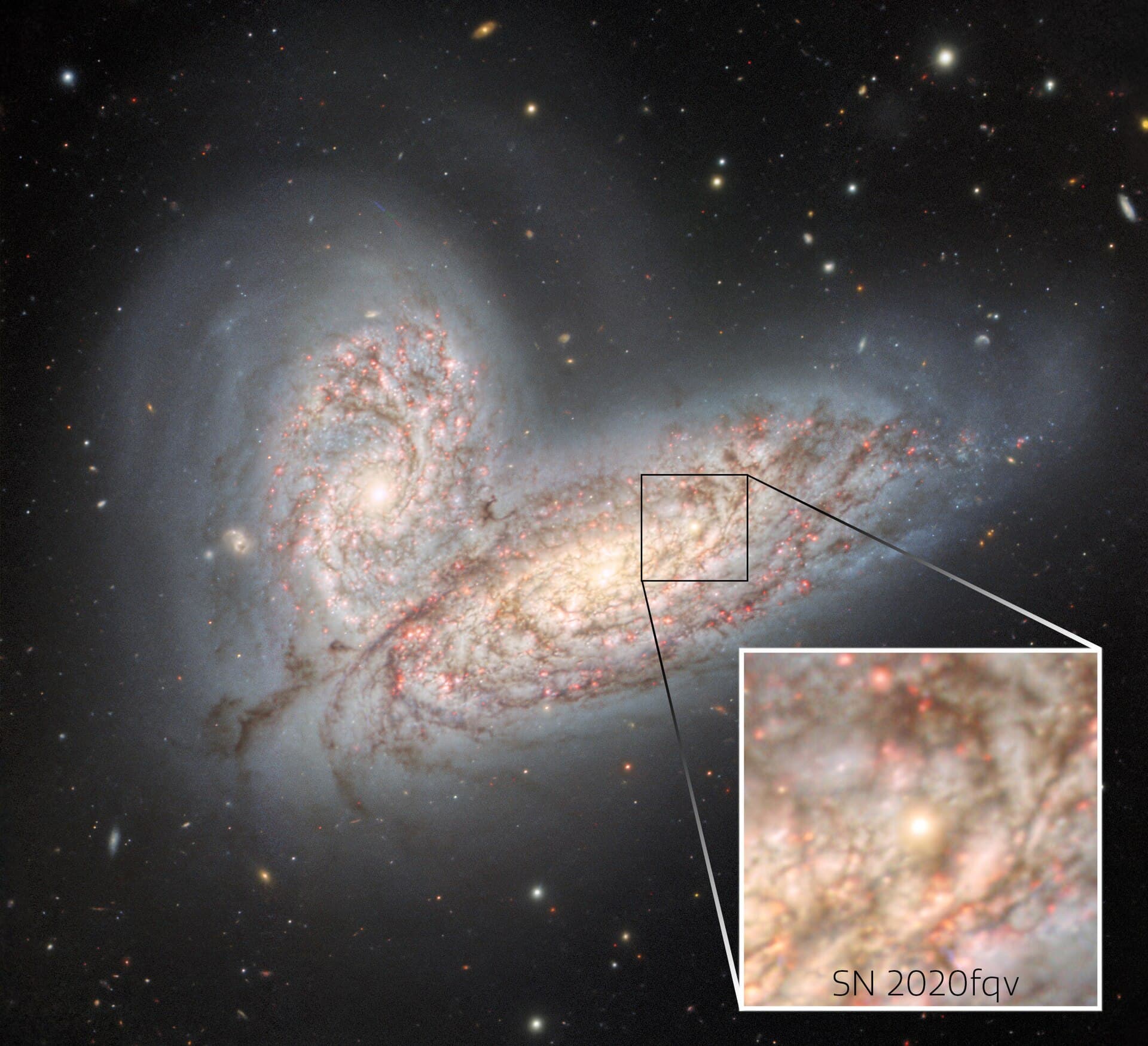
60 million light-years away in the Virgo Cluster, two spiral galaxies – NGC 4567 and NGC 4568 – star in one of the most evocative images in modern astronomy: the "cosmic butterfly" (or "Siamese twins"), captured by the Gemini North telescope in Hawaii as they just begin to collide and merge.
For now, the scene is placid: the galactic centers are 20,000 light-years away from each other—like from Earth to the center of the Milky Way—and each galaxy retains its pinwheel shape. But gravity is already doing its job: When they get closer, tidal forces will trigger bursts of star formation and warp the spirals into a single elliptical galaxy about 500 million years from now.
You may also likeLa tripulación de Shenzhou-23 recupera muestras biológicas expuestas al espacio durante cinco mesesThe image, published by NOIRLab, brings an extra: the afterglow of the supernova SN 2020fqv, detected in 2020 in one of the arms of NGC 4568. Astronomers believe that the pair will end up resembling its mature neighbor Messier 89, an elliptical of the same cluster already without gas to form stars.
The scientific value goes beyond the postcard: combining decades of observations and models of mergers like this one confirms that colliding spirals become elliptical, and offers a preview of what awaits our galaxy when the Milky Way and Andromeda collide in ~5 billion years.
The video circulating this week on Telegram recovers that image from 2022 and puts it flying again: 60 million light-years are nothing compared to a good cosmic time-lapse.
Galactic moral: even the most majestic structures in the universe end up mixed. The butterfly, for now, continues to flap its wings.
You may also likeSpaceX atrapa el cohete Starship en la torre de lanzamiento por primera vezImage credit: NGC 4568/4567 pair and supernova SN 2020fqv, Gemini International Observatory/NOIRLab/NSF/AURA via Wikimedia Commons, licensed under CC BY 4.0.