The United States and China are racing their pulse for lunar energy: small nuclear reactors to power bases at the moon's south pole. Washington is aiming for 2030 and the Russia-China axis for 2036 to deploy the first lunar reactor, according to DongA Science.
Without power there is no permanent base: the lunar night lasts 14 Earth days and solar panels are not enough. The reactor is the piece that turns a visiting camp into a settlement that works continuously.
You may also likeBepiColombo ya orbita Mercurio: un fallo de software acortó la maniobra, pero la misión sigue en pieOn the U.S. side, NASA's Moon Base program is progressing in phases: robotic missions and technology demos first, infrastructure to live and work later, with the south pole as the headquarters and Mars as the declared final destination.
On the other hand, China is stepping on the accelerator with Long March 10, the Mengzhou spacecraft and the Lanyue lunar lander, a manned moon landing before 2030 and Chang'e-7 looking for ice in 2026, plus the ILRS station with partners such as Pakistan.
The race is no longer about flags but about megawatts: whoever turns on his jet first sets the rules of the neighborhood – frequencies, corridors, exclusion zones – in the only real estate that matters 384,000 kilometers away.
And there is an expiration date for the orbital status quo: the ISS retires between 2030 and 2032, and Tiangong could remain as the only station. The Moon is the next board, and both sides are already moving pieces.
You may also likeHera muestra el cráter gigante que DART dejó en Dimorphos y confirma que desviar un asteroide es posibleAt the same time, NASA hunts underground caves as shelters and maps hidden ice: the base will not be a dome on the plain but a system – surface, subsurface and orbit – designed to survive and make the leap to Mars.
Sources
DongA Science: US and Russia-China race for the first lunar reactor
NASA: Moon Base Program
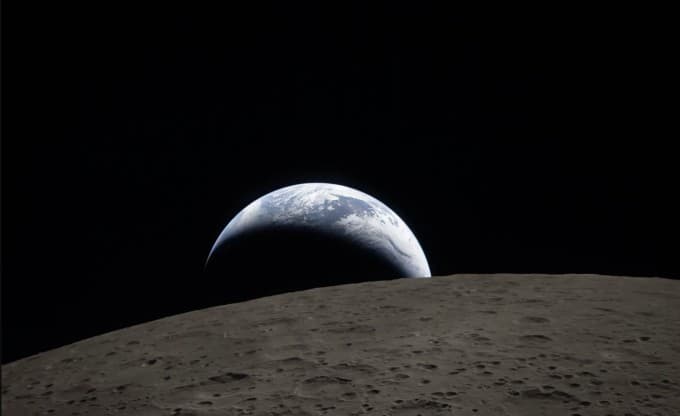
Image credit: Earthrise as seen from the Moon, Artemis II mission image via DongA Science/NASA.