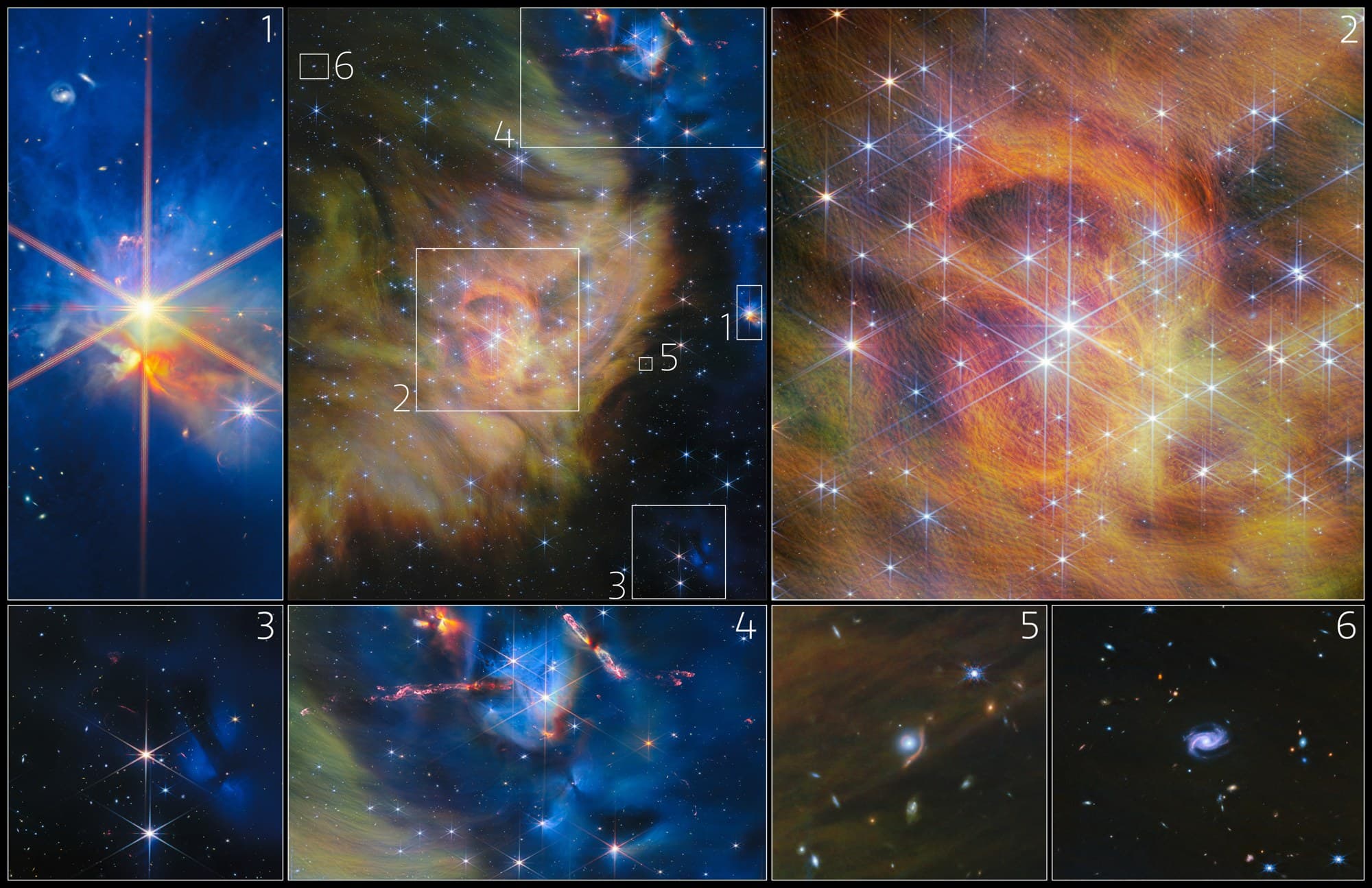
The Webb telescope released one of its largest images to date: a panorama of IC 348, a stellar nursery 1,000 light-years away in Perseus, where it searched for brown dwarfs and found some barely twice the mass of Jupiter, an unprecedented mass range that stresses theories of star formation.
The NIRCam image also shows young stars ejecting jets that collide with gas and dust, sculpting the landscape. The visible curtains are reflection nebula—starlit dust—with carbon molecules (PAHs).
Two binary blue giant stars, the most massive in the cluster, help sculpt the large loop visible on one side of the field with their winds. Seeing the entire scaffolding, from gas to dwarfs, in a single view is what makes this mosaic valuable.
It was released by NASA, STScI and ESA in September 2026. Each agency underlines the same thing: objects at the boundary between star and planet, now observable by the dozens.
The finding opens a new window: If Jovian two-mass dwarfs are common, models of molecular cloud collapse need tweaking. IC 348, just around the corner in cosmic terms, is the ideal laboratory.
Sources:Signals from Space (Telegram) · NASA Science · STScI · ESA
You may also likeSpaceX atrapa el cohete Starship en la torre de lanzamiento por primera vezIt was released by NASA, STScI and ESA in September 2026. Each agency underlines the same thing: objects at the boundary between star and planet, now observable by the dozens.
The finding opens a new window: If Jovian two-mass dwarfs are common, models of molecular cloud collapse need tweaking. IC 348, just around the corner in cosmic terms, is the ideal laboratory.
Sources:Signals from Space (Telegram) · NASA Science · STScI · ESA
Image credit: IC 348 by Webb: ESA, NASA, CSA, K. Luhman, C. Alves de Oliveira via Wikimedia Commons, licensed under CC BY 4.0.