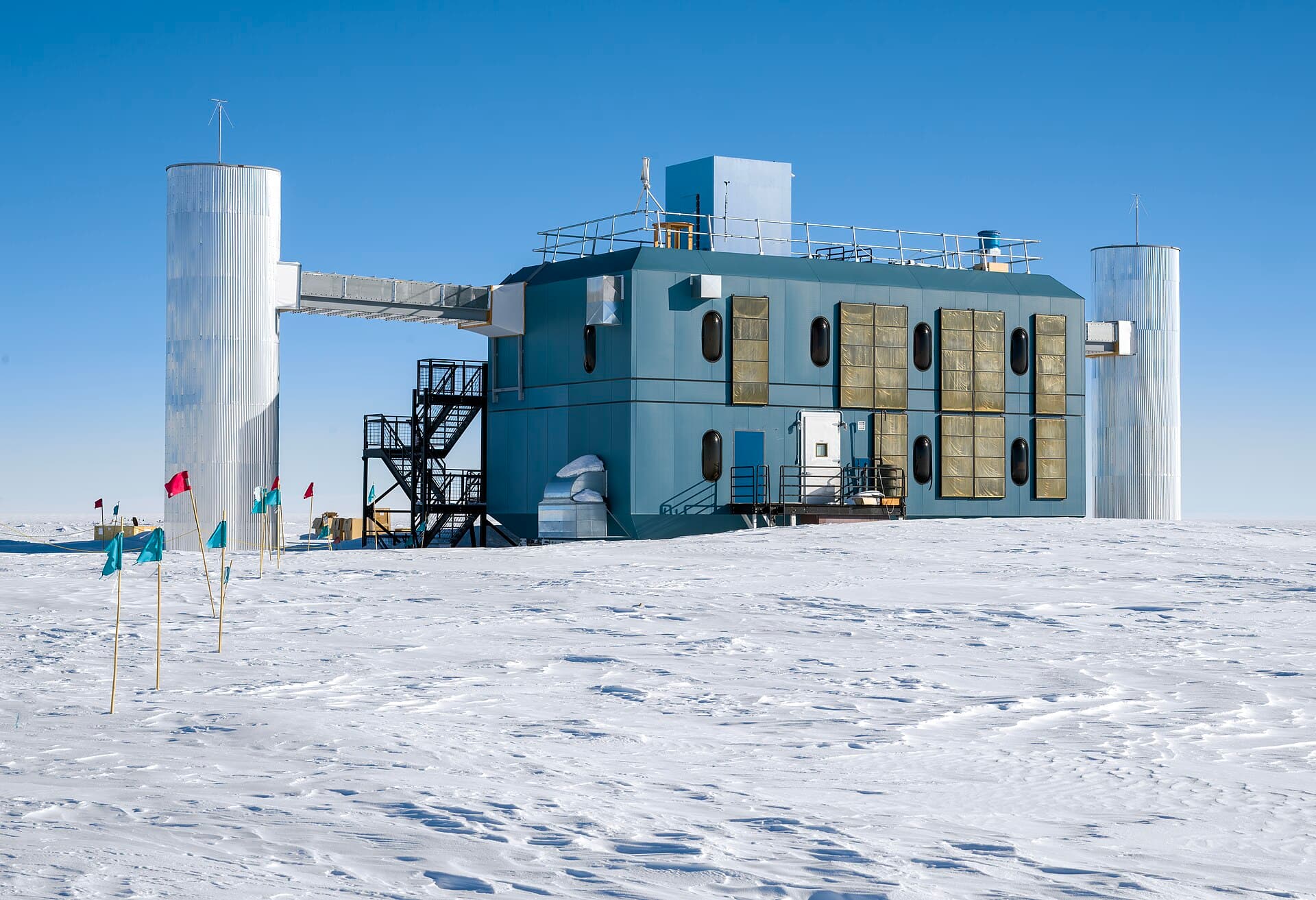
On October 6, the Royal Swedish Academy of Sciences awarded the 2026 Nobel Prize in Physics to Francis Halzen, an 82-year-old Belgian physicist based at the University of Wisconsin-Madison, "for his decisive contributions to the IceCube Neutrino Observatory and the discovery of high-energy neutrinos of astrophysical origin."
Halzen's idea dates back to the late 1980s: to use crystalline ice from the South Pole as a detector. The result is IceCube, a cubic kilometer of ice with thousands of digital sensors buried more than two kilometers below the surface — about 8,200 detectors. When a neutrino collides with the ice, it produces a flash of light that the sensors capture; the transparency of the ice allows signals to be recorded that, in any other material, would be lost.
You may also likeCOP31: el mundo pierde la batalla contra el petróleoNeutrinos — called "ghost particles" because of their minuscule mass and ability to pass through the Earth almost without interacting — exist in immense numbers but rarely leave a trace. IceCube managed to capture the first high-energy neutrinos from distant galaxies, and in 2025-2026 the collaboration also announced the discovery of neutrinos from our own galaxy, the Milky Way.
The Nobel committee called it "ghost messages from space" and noted that the experiment opened up a revolutionary way of understanding the universe that didn't exist before. "This experiment in Antarctica is a revolutionary way to understand the universe that we didn't have before," said Michael Moloney, executive director of the American Institute of Physics.
Halzen, who was IceCube's principal investigator since its inception, dedicated the award to the team: "I hope this reflects the very brave people who joined me at the beginning of this project," he said after the announcement. The infrastructure continues to grow: the IceCube Upgrade was installed in 2025-2026 to lower the energy threshold and better calibrate the ice, with the first scientific data expected by the end of the year.
The prize cements a decade of high-energy physics looking downwards: instead of underground accelerators, a cubic kilometer of ice at the edge of the planet as a telescope. The University of Wisconsin-Madison is the lead institution for the observatory, which is funded by the U.S. National Science Foundation .
You may also likeUn paciente de Neuralink ya juega GTA VI solo con su implante cerebralSources
NSF: Nobel for IceCube discoveries · IceCube: Halzen wins 2026 Nobel · NPR/Associated Press · Scientific American
Image credit: IceCube Neutrino Observatory, photo by Christopher Michel via Wikimedia Commons, licensed under CC BY-SA 4.0.