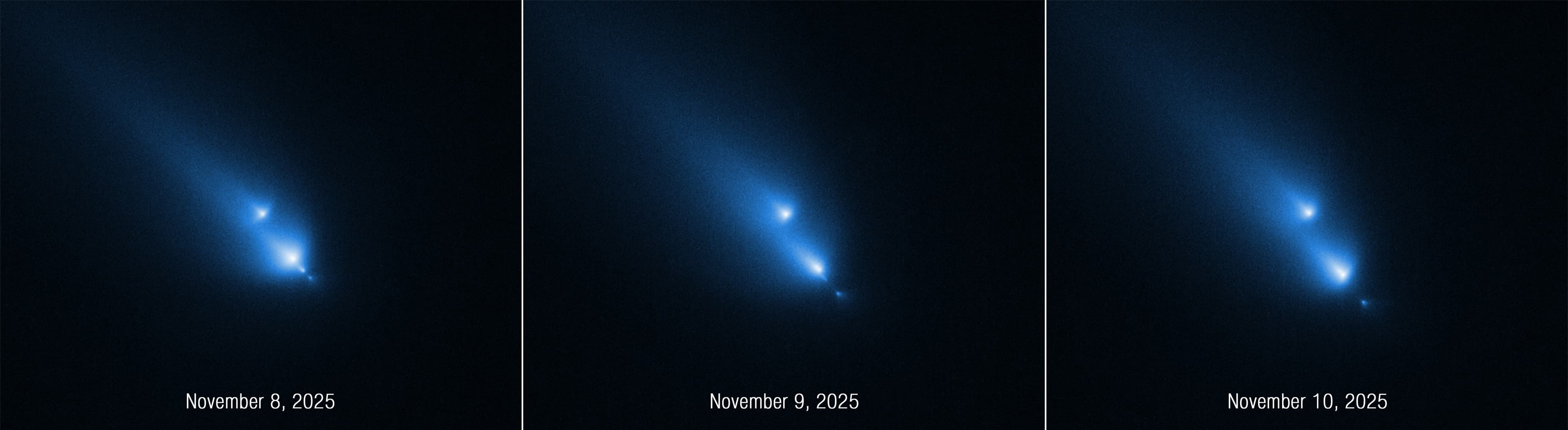
Comet C/2025 K1 (ATLAS) was captured disintegrating live: Hubble photographed it on November 8, 9, and 10, 2025 in three 20-second exposures and watched it break into at least five pieces, each with its own comma.
It's the first time Hubble has witnessed such an early break.
It's the first time Hubble has witnessed such an early break.
The object, about 8 kilometers long and originating in the Oort cloud, had survived its perihelion on October 8, 2025 and began to yield to heat and solar gravity. From the ground, only fuzzy spots were visible; Hubble resolved each fragment sharply.
A mystery remained: Why did it take so long to see the glow of the breakup from the ground, if the exposed fresh ice must have glowed instantly? The reconstructed timeline doesn't square with expectations, and solving it will say something new about how comets die.
The North Gemini (Maunakea, Hawaii) followed on November 11 and December 6: three fragments fluctuating night by night in brightness, density, and position. It was NOIRLab's image of the week in January 2026.
Two giant telescopes, same verdict: the comet falls apart.
You may also likeLa tripulación de Shenzhou-23 recupera muestras biológicas expuestas al espacio durante cinco mesesA mystery remained: Why did it take so long to see the glow of the breakup from the ground, if the exposed fresh ice must have glowed instantly? The reconstructed timeline doesn't square with expectations, and solving it will say something new about how comets die.
The North Gemini (Maunakea, Hawaii) followed on November 11 and December 6: three fragments fluctuating night by night in brightness, density, and position. It was NOIRLab's image of the week in January 2026.
Two giant telescopes, same verdict: the comet falls apart.
Not to be confused with the interstellar 3I/ATLAS: this K1 is from the solar system, a visitor to the distant Oort cloud on its way out after touching the Sun.
Temporal transparency: the observations are from November-December 2025 and the communiqués from January-March 2026; the channel rescued it on September 29 and the case is still ongoing because the disintegration is still under study.
Sources
Signals from Space (Telegram) · NOIRLab / Gemini North · NASA SVS (Hubble)
Sources
Signals from Space (Telegram) · NOIRLab / Gemini North · NASA SVS (Hubble)
Image credit: C/2025 K1 fragmentation: NASA, ESA, D. Bodewits via Wikimedia Commons, licensed under CC BY 4.0.