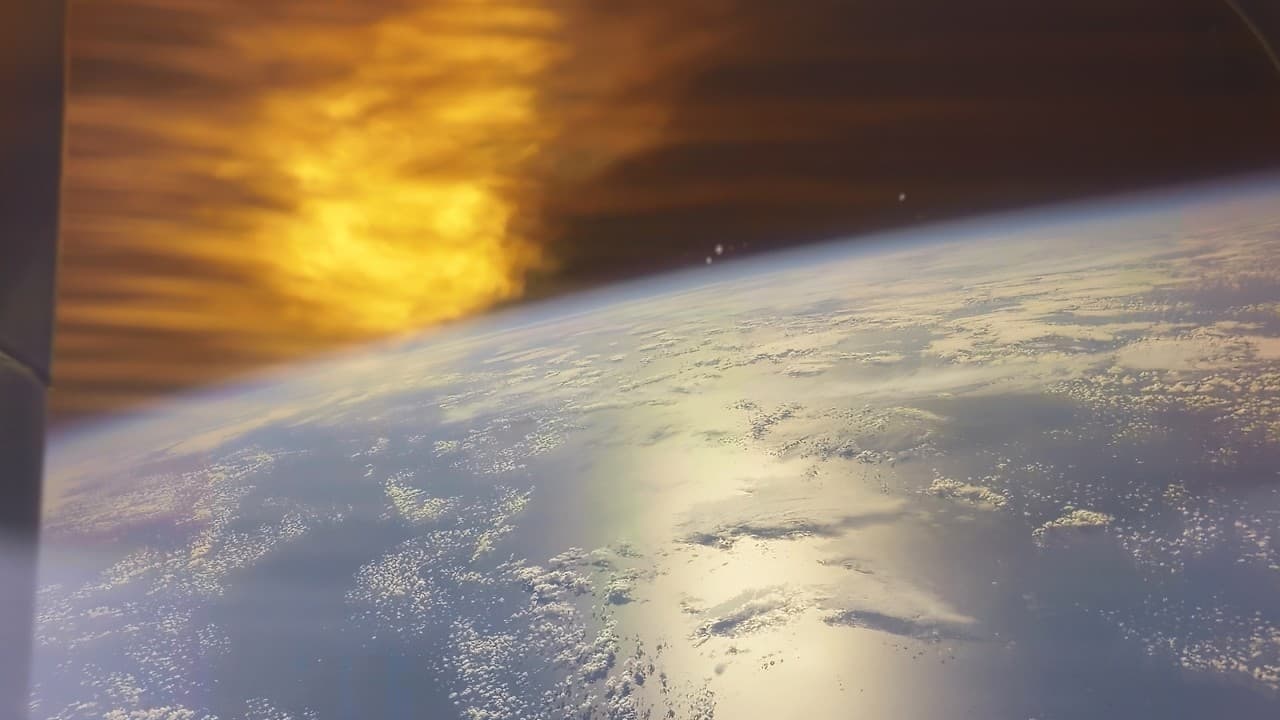
NASA released the video of the re-entry and splashdown of the Artemis II Orion capsule, which brought back the crew on April 10: a GoPro Hero 4 Black installed in the pilot's window (the "Cabcam2") recorded the fall from 2,000 km altitude at 33,000 km/h to the Pacific. The news is brought by Microsiervos.
The version on the road is processed by Simeon Schmauß to eliminate the distortion of the wide-angle lens, which deforms the horizon. The re-entry itself starts about 10 minutes after the start, when it reaches the entry interface at 122 km flying at almost 40,000 km/h. From this point of view, the most striking thing is the plasma tail left by the capsule and the oscillations from side to side as it maneuvers towards its splashdown area.
You may also likeLa tripulación de Shenzhou-23 recupera muestras biológicas expuestas al espacio durante cinco mesesThe audio is another document: you can half-hear the crew – Wiseman, Glover, Koch and Hansen – and Jenny Gibbons talking to them, but what you hear perfectly is the knocking of the shunting engines (RCS) every time they are activated. There were more cameras on board; those videos are not yet available.
The trajectory was modified from Artemis I, whose heat shield came back badly damaged — damage that actually delayed Artemis II. The change worked spectacularly: from more than 100 points with material loss to only nine, shallower. NASA's initial assessment confirms the accuracy: splashdown 2.9 miles from the predicted point and entry speed at one mile per hour than predicted.
It was the closing of a mission of almost 10 days and 252,756 miles of maximum distance – record for the farthest manned flight, above Apollo 13 – with the first woman (Koch), the first African-American (Glover) and the first Canadian (Hansen) flying next to the Moon. The splashdown was on April 10 at 8:07 pm EDT off San Diego, NASA details.
The breakdown report has its irony: the most serious problem of the entire flight was the malfunction of the toilet. And the hangover: we will have to wait at least until the summer of 2027 for the next launch of the program. The Moon can wait; the GoPro, not.
You may also likeSpaceX atrapa el cohete Starship en la torre de lanzamiento por primera vezSources
Micro Servants · NASA: Artemis II Splashes Down · NASA: Initial Assessments · @microsiervos (Telegram)
Image credit: Orion re-entry video, NASA via Microsiervos (screenshot from NASA video).