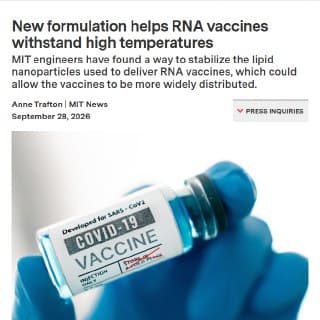
MIT researchers used artificial intelligence to design a solid-state thermostable mRNA vaccine that retains 100% of its bioactivity after more than two months at 37 °C, without a cold chain. The work, published on September 28 in Nature Biotechnology, opens the door to distributing these vaccines in countries without refrigeration and applying them with microneedle patches instead of injections.
The numbers are strong: The formulations stabilized vaccines with two clinically available lipid nanoparticles—those from Moderna (SM-102) and Pfizer-BioNTech (ALC-0315)—and generated IgG antibody and germline center B cell responses that were no inferior to those of fresh vaccines. Incorporated into solvent patches and tested in rodents and non-human primates, they gave neutralizing antibody titers comparable to traditional intramuscular injection.
You may also likeEE. UU. limita el acceso remoto a chips de IA desde Singapur, Malasia, Tailandia, Indonesia y BrasilThe tool is called AGENT (Algorithm-Guided Experimental design for lipid Nanoparticle Thermostabilization): it combines high-throughput experimentation with Bayesian optimization to explore the formulation space. Where manual searching took months with suboptimal results, AGENT extracted maximum sparse data and optimized in six iterations in one month, according to bioRxiv's preprint on September 17.
The problem it attacks is structural: mRNA nanoparticles require deep-freezing, which blocks their global distribution and use in advanced systems such as patches. Solid, waterless formulations nip that requirement in the bud and enable the cutaneous pathway, where the skin — rich in immune cells — responds strongly.
The team is from the Koch Institute and five departments at MIT (including the laboratories of Langer and Jaklenec), as stated in PubMed. And they are not starting from scratch: the same lineage published in 2024 the patch vaccine printer (MIT News, 2023), capable of producing 100 patches in 48 hours stable months at room temperature.
The necessary nuance: the trials are in rodents and primates, not in humans, and clinical translation is lacking. But the authors claim the first demonstration of AI-guided design of thermostable RNA vaccines, with real clinical compositions, not just in the laboratory.
You may also likeGoogle detecta por primera vez un agente de IA que convierte parches de seguridad en exploits sin intervención humanaIf the escalation confirms what has been seen in animals, immunization without a cold chain would cease to be a promise: patches that travel without refrigeration, are applied without a needle and protect the same. For poor countries, the difference between getting vaccinated or not.
Sources
Aipost (Telegram) · Nature Biotechnology · bioRxiv (preprint) · PubMed (MIT affiliation) · MIT News (printer 2023)
Aipost (Telegram) · Nature Biotechnology · bioRxiv (preprint) · PubMed (MIT affiliation) · MIT News (printer 2023)
Image credit: Aipost (Telegram), source image.