AI can go from memorizing to discovering rules. Mechanistic interpretability—a technique for analyzing what happens inside language models—finds signs that these systems create internal representations of concepts and relationships between facts, beyond associating words.
The star phenomenon is called grokking: after a long period with little progress, the model can begin to solve new problems by generalizing an underlying rule that no one programmed it with. For the first time, it was verified in pretraining of real LLMs on a practical scale: grokking occurs by groups of data locally and asynchronously, not globally, according to arXiv 2506.21551 (Feb-2026).
You may also likeExpertos advierten que laboratorios de IA ocultan revelaciones sobre riesgos globalesThe proposed mechanism is elegant: internal paths (choices of experts per layer in MoE) evolve from random and specific to structured and shared between samples. The similarity between routes and the consistency between layers grow during grokking: generalization emerges from ordering the interior, not from memorizing more.
And there are already laws of scale: a September 2026 study maps the memorization-generalization boundary in 384 configurations and finds that data complexity rules (duplicating data accelerates ~4x generalization; doubling width, only ~1.2x), with a sharp phase boundary in weight decay, according to arXiv 2609.10657.
The caution is provided by the literature itself: a grokkee does not always reason for a new circuit—sometimes it only integrates memorized facts into existing routes—and generalizing and forming a circuit can occur separately. The "aha!" of the model is not the same as understanding as a person or constructing a complete model of the world.
Even so, the program advances: measuring progress during training (restricted/excluded losses, weight compression) allows us to anticipate jumps that the classic loss does not see. Understanding the inside is no longer a philosophy but an instrumentation.
You may also likeAnthropic afirma que la "singularidad" ya comenzó, según Jack ClarkThe classical origin is still valid: the work of Nanda et al. (ICLR 2023) divided the phenomenon into memorization, circuit formation, and cleanliness, with Fourier multiplication emerging in a single layer. What was toy curiosity in modular arithmetic is now measured in models of billions of parameters.
Sources
arXiv 2506.21551: memorization-to-generalization in MoE
arXiv 2609.10657: Transition Scale Laws
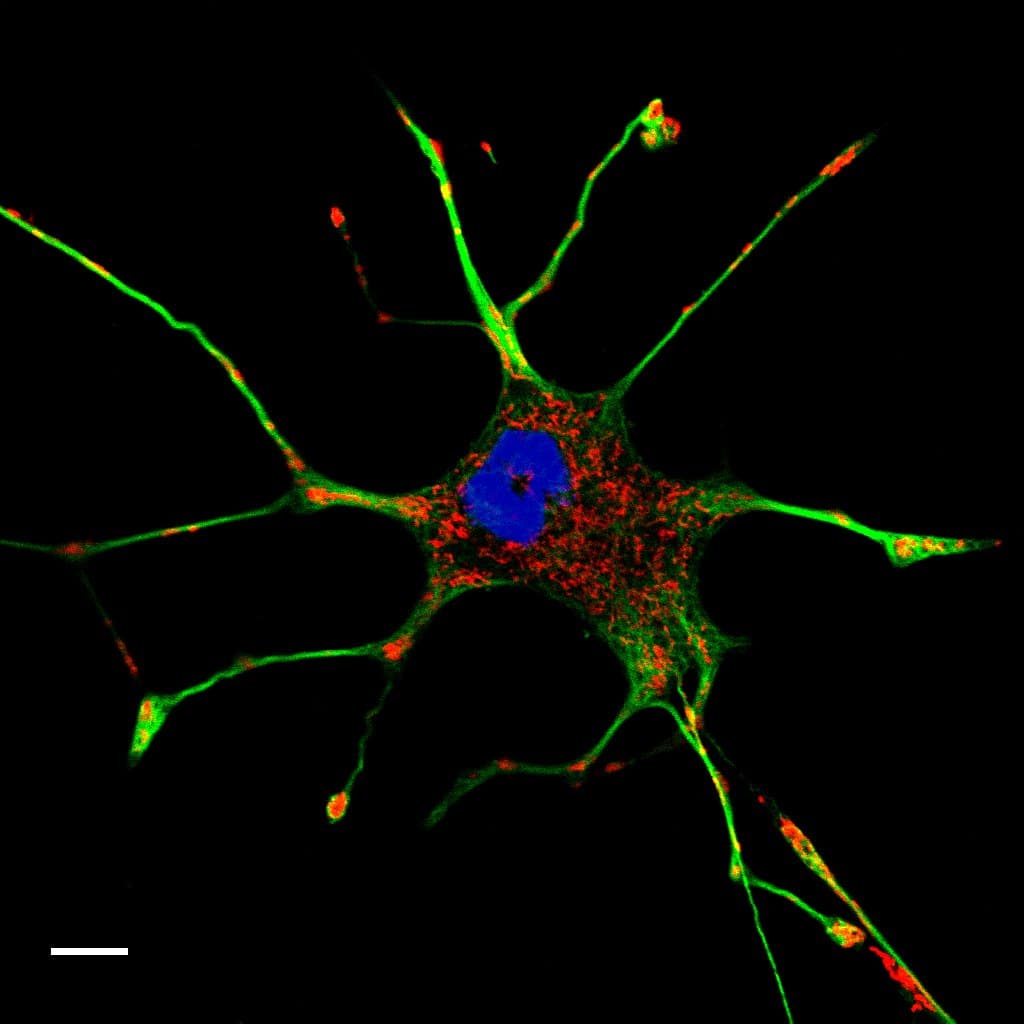
Image credit: Live PC-12 cell in multicolor fluorescence, image by 8x57is, CC BY-SA 4.0 license via Wikimedia Commons.