Nine of the 353 open Erdős problems that were put in front of him have fallen to an AI agent, and another 44 of 492 conjectures about integer sequences have been proven. These are statements that had been unclosed for years, in some cases decades, – including two open questions for 56 years – according to the paper "Advancing Mathematics Research with AI-Driven Formal Proof Search".
Each test was written in Lean, the formal language in which the computer checks step-by-step that the reasoning has no gaps. The agent solved 9 of 353 at an inference cost of a few hundred dollars per problem, with a limit of 3,000 search episodes per statement.
You may also likeUltrasonido mapea por primera vez un riñón humano completo en 3DWhat validates a human is that the statement in Lean is faithful to the original conjecture, and that was done by experts on the team after each resolution. To shield himself against erroneous formalizations in OEIS, the agent had to first test "test lemmas" with the first terms of each sequence. The tests are public and appear on the wiki that Terence Tao maintains on AI's contributions to Erdős' problems.
The spoils do not end there: the same agent solved a 15-year-old question on Hilbert functions in algebraic geometry, improved an open bound in convex optimization with an unprecedented parameter scheme, detected erroneous formalizations in the literature and is already working on combinatorics, graph theory, algebraic geometry and quantum optics, as summarized by PubMed (Oct 8, 2026).
The honest nuance is provided by the authors themselves and the parallel experience of DeepMind: only a fraction of the mathematical literature is formalized in Lean, many statements are ambiguous, and the "open" status of several problems solved more obscurity than difficulty. AI, here, is both a gap detector and a solver.
The agent shows his work line by line, so it costs considerably less to check than to follow a handwritten proof. Machine-verifiable mathematics ceases to be a promise and becomes a method—and there are nine notches on Erdős's board.
You may also likeUn chip de Harvard genera luz ultravioleta en miniatura y acerca la computadora cuántica al tamaño de un chipThe context is a formal spring: the open repository Formal Conjectures already brings together Lean statements from part of Bloom's catalog (more than 1,200 problems by Erdős and collaborators), and the Tao wiki records weekly solutions from Aristotle, GPT, Claude, Codex and Gemini. The race to formalize mathematics is advancing faster than that of solving it by hand.
Sources
arXiv: Formal search for evidence with AI (abs + HTML)
Terence Tao's Wiki: AI's Contributions to Erdős' Problems
PubMed: study summary (Oct 8, 2026)
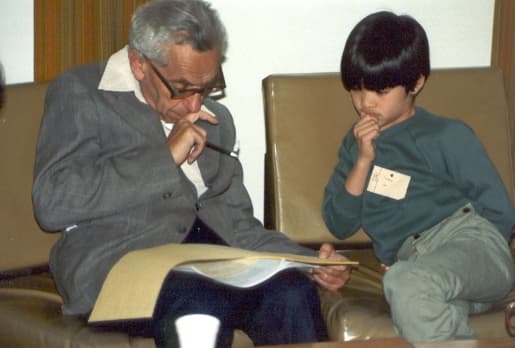
Image credit: Paul Erdős with the young Terence Tao, photograph by Billy or Grace Tao, CC BY-SA 2.0 license via Wikimedia Commons.