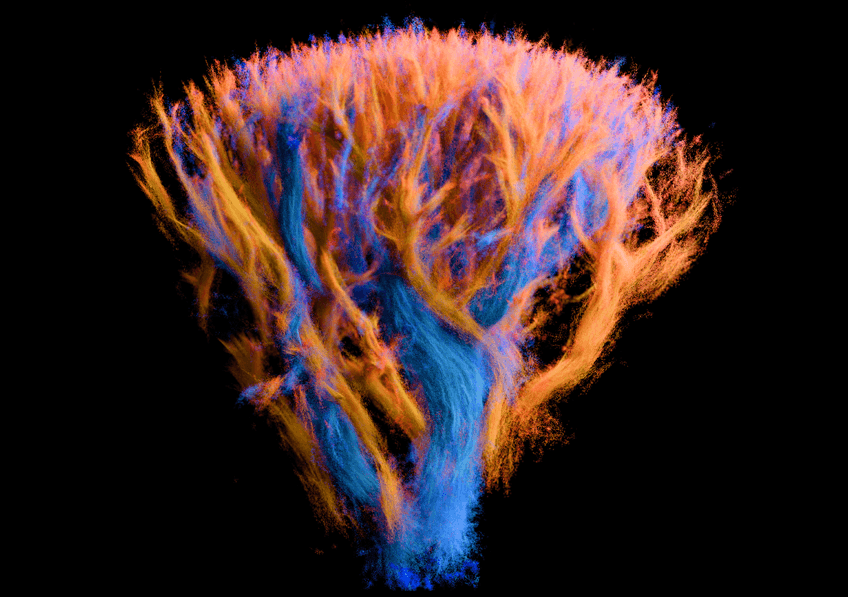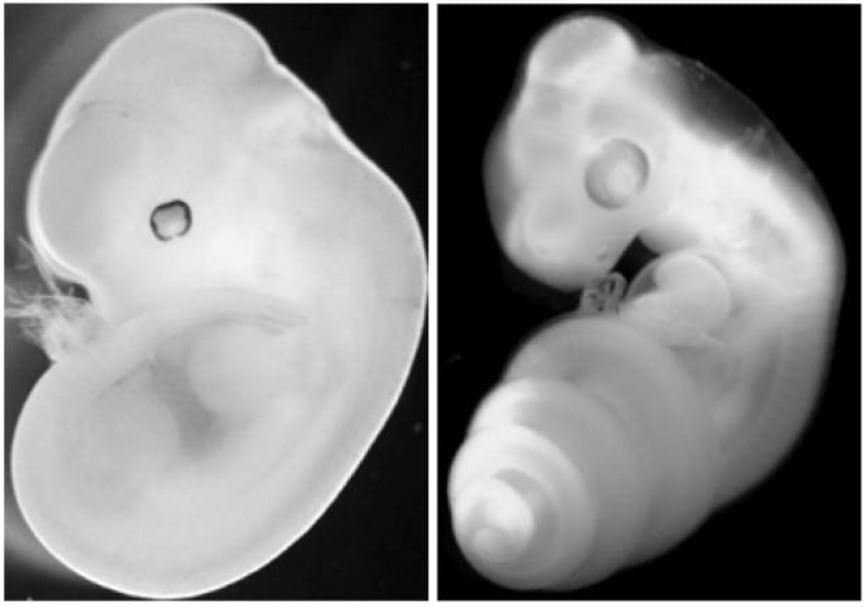
A 13.5-day-old mouse embryo, traced cell by cell to the egg from which it emerged. A single fertilized cell becomes 1.28 million in less than two weeks, and each now has its genealogy written on it: Using a technology that etches marks into DNA as cells divide, the team read those marks and reconstructed the largest lineage tree of a mammal, according to the University of Washington (Oct. 8, 2026).
The technique is called DNA Typewriter: a "tape" inserted into the egg's genome that records each division as if stamping a passport. By reading 1.3 million cells with a transcriptional profile, the resulting tree is parsimonious, calibrated in time and rooted in the zygote: it is seen which branches ended up in which tissues and organs.
You may also likeNHS prueba IA para detectar cáncer de mama en el ensayo más grande del mundoIt wasn't a single team: Two groups mapped early development in parallel (the other, with PEtracer, surpassed 1.4 million cells in 16 embryos), and Science highlighted convergence. Embryology enters its era of total accounting, as ChosunBiz reported.
The next step is to apply the record to other organisms and more stages, to compare how lineages branch out when something goes wrong: malformations, cancer, regeneration. The healthy tree will be the benchmark against which to measure the crookedness.
And there is a philosophical detail: each cell in your body carries a history of divisions that, in principle, could be read. We are walking genealogies.
The work, published in Science, also sets a technical record: phylogeny of 1.28 million cells profiled from a single embryo. A scale that was unthinkable five years ago.
You may also likeUltrasonido mapea por primera vez un riñón humano completo en 3DThe technique also promises to distinguish founder cells with 99% accuracy: knowing how few initial cells each organ produces changes how congenital defects are studied and regenerative therapies are designed.
Sources
Univ. Washington: DNA Typewriter in Early Embryo
ChosunBiz: typewriter maps lineages and disease
Image credit: Mouse and snake embryos (cropping without tags), image by Joost M Woltering, CC BY 2.5 license via Wikimedia Commons.